

Isaiah Bailey leads the national touring cast in Andrew Lloyd Webber’s gothic romance, delivering powerful vocals and an especially moving second act.
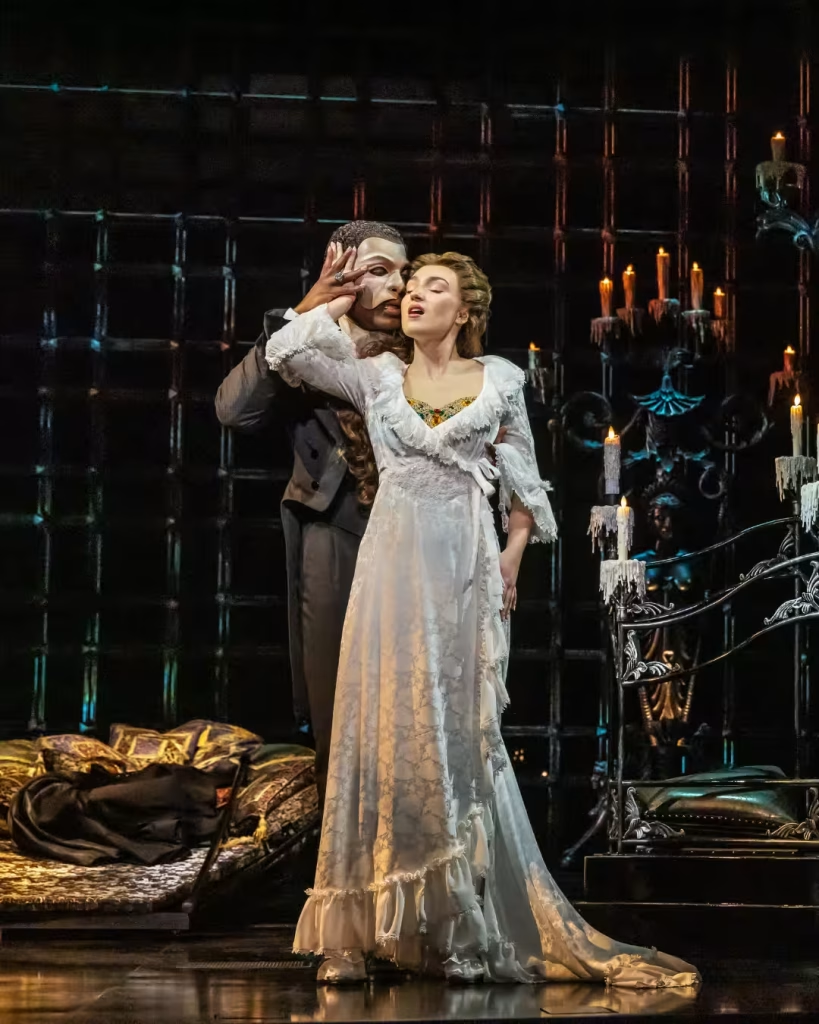
Few musicals have the staying power of Andrew Lloyd Webber’s The Phantom of the Opera. With its sweeping score, gothic romance that occasionally teeters on melodrama, and lavish theatrical spectacle, the story of a mysterious musical genius who haunts the Paris Opera House has captivated audiences for decades. The music is instantly recognizable, from the haunting title song to the soaring love songs, but seeing the story unfold live is what gives those familiar melodies their emotional weight.
For me, The Phantom of the Opera has a particularly personal history. I first saw it in London with my parents when I was around my daughter’s age. I remember being blown away by the acting, the singing and the sheer majesty of the stage. But one moment, in particular, made me fall in love with the musical.
During the Act I reprise of “All I Ask of You,” I could see tears streaming down the Phantom’s face. My young heart ached for him. Even then, I was moved by the contradiction at the center of his character: a man capable of creating such extraordinary beauty through music, yet so consumed by loneliness, rejection, and longing that he struggles to understand the difference between love and possession.
Decades later, we had the chance to introduce our 8-year-old daughter to the same story at The Smith Center in Las Vegas, where the national touring production is playing through November 1.
Dan and I sing The Phantom of the Opera around the house often enough that Livia already knew the music. She had heard the melodies echoing through our home for years, but she didn’t know the story behind them. Now she would discover the Phantom, Christine, Raoul and the secrets hidden beneath the opera house for herself.
(Be sure to follow FoodFamilyTravel.com on News Break and on Instagram: @food.family.travel for the latest travel, entertainment & lifestyle stories, trends and tips)
A theatrical phenomenon
Based on Gaston Leroux’s 1910 novel, The Phantom of the Opera premiered in London’s West End on October 9, 1986, before opening on Broadway in January 1988. The original Broadway production ran for 35 years, closing in April 2023 after 13,981 performances. It remains the longest-running show in Broadway history.
The story follows Christine Daaé, a young soprano whose extraordinary voice attracts the attention of a mysterious, masked musical genius living beneath the Paris Opera House. The Phantom secretly teaches and guides her, convinced she is destined for greatness. But his devotion becomes increasingly possessive, particularly as Christine reconnects with Raoul, a childhood friend who falls in love with her.
It’s a story of music, desire, passion, obsession, rejection and the human need for connection, brought to life through elaborate costumes, dramatic scenery- including instantly recognizable recreations of my favorite theater in the world, Paris’ Palais Garnier- graceful ballet and a sweeping score that moves effortlessly between romance and suspense.
This touring production, directed by Seth Sklar-Heyn based on Harold Prince’s celebrated original direction, retains Maria Björnson’s iconic designs, with musical staging and choreography by Gillian Lynne, recreated and adapted by Chrissie Cartwright.
Isaiah Bailey’s Phantom takes center stage
The cast is filled with impressive singers, and the score gives them plenty of opportunities to show off their vocal range. But Isaiah Bailey’s Phantom is the performance that stands out.
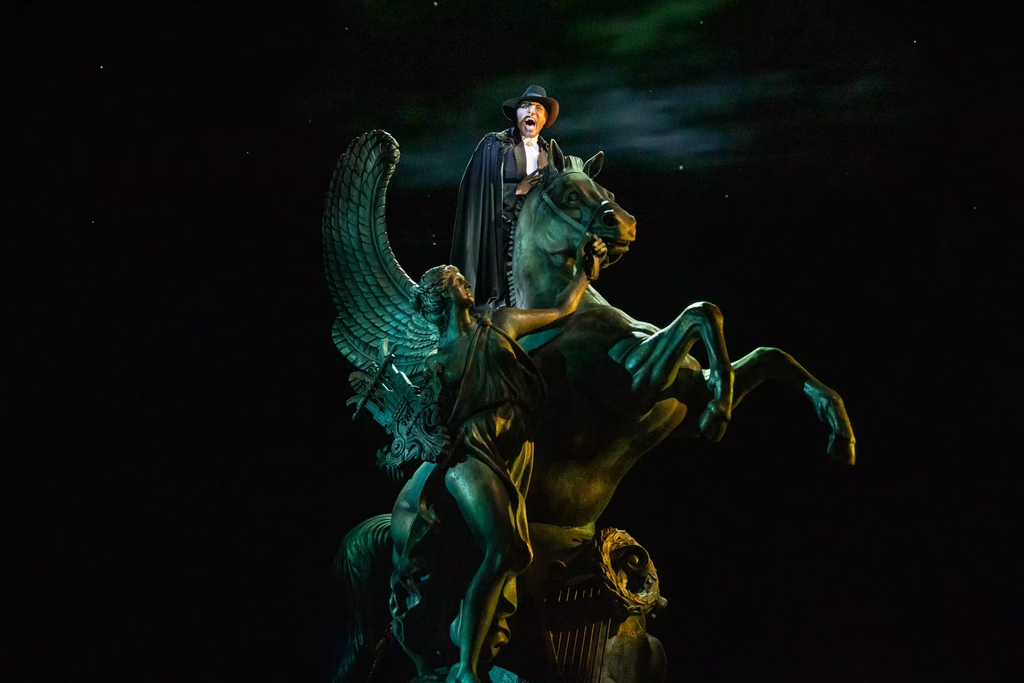
The Act I finale was one of the highlights for me. It’s the same sequence that made such an impression when I first saw the musical in London, and Bailey brings real feeling to the Phantom’s anguish. The music builds with soft and sad vocals, the tension escalates, and the character’s emotional turmoil comes into focus. Knowing what is coming doesn’t diminish the scene’s impact.
Act II, however, belongs to Bailey.
As the story moves toward its final confrontation, he brings greater emotional depth to the Phantom, allowing the wounded man beneath the mask to emerge alongside the character’s darker impulses. The Phantom is frightening, manipulative and obsessive, but he is also profoundly lonely. Bailey gives us glimpses of that vulnerability, making it easier to understand why the character inspires both fear and sympathy.
That balance is essential to the role. The Phantom’s actions are often indefensible, but the tragedy of his character lies in his inability to separate his extraordinary gifts from his desire to be loved. Music is the one language in which he can express himself fully, yet even that cannot give him the relationship he craves.
Bailey makes the most of those contradictions, particularly in the second act, when the emotional stakes are highest.
Jordan Lee Gilbert has a beautiful soprano and moves across the stage with the grace and fluidity of a dancer. She handles the incredibly demanding score with ease, but it’s her scene with the Phantom in the graveyard in Act II that finally delivers the emotional connection I had been hoping to see throughout the show. Through their movements and mirrored body language, we get a glimpse of the bond between them- and what this production could achieve with a few subtle adjustments to bring that connection to life more consistently.
Importantly, their relationship begins long before the story unfolds onstage. The Phantom has been teaching Christine, developing her voice and nurturing her talent well before the curtain rises. Music is the passion that binds them, and I wanted to feel the depth of that connection from the moment he appears in her mirror to the moment he leads her beneath the opera house. There should be something almost magical about their bond, a shared devotion to music that Christine cannot easily walk away from, even as his devotion turns into obsession.
That is what makes this story so much more interesting than a simple love triangle. The Phantom and Christine share something Raoul cannot quite offer: a deep artistic connection built around the music that has shaped her. Their connection doesn’t have to be romantic to be powerful or to create a pull Christine cannot easily resist. But we need to feel the depth of their bond to understand why she is drawn to the Phantom, why his rejection cuts so deeply and why his heartbreak becomes so consuming. The graveyard scene shows how effectively that connection can come through. I would have loved to see more of that emotional interplay throughout the production.
Daniel Lopez brings a capable voice and an appealing presence to Raoul. I would have loved to see a little more chemistry between him and Christine to make their romance feel as compelling as the music. By the time they sing “All I Ask of You,” I want to believe these two are completely in love. They should be drawn to each other almost instinctively, with a connection that feels immediate and undeniable. At times, the distance between them onstage makes that harder to feel. A little more intimacy and urgency could help establish the depth of their relationship- and make the Phantom’s presence all the more threatening.
This is a story fueled by longing, jealousy and the need to be seen and loved. When those feelings come through, the Phantom’s heartbreak is what makes the story linger.
Carlotta, comic relief and an opera house in chaos
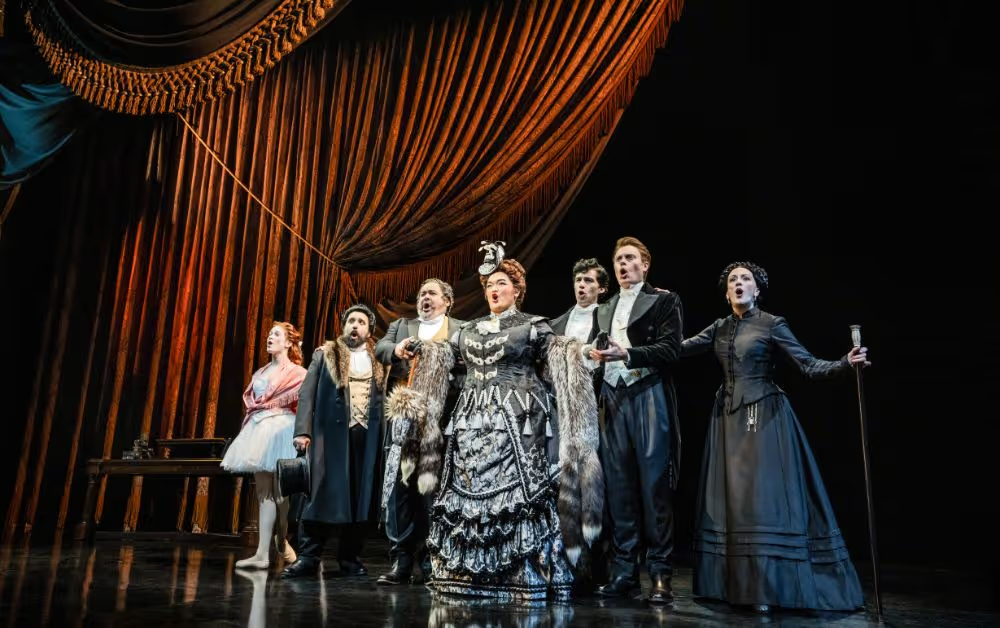
Midori Marsh is a delight as Carlotta Giudicelli, the opera house’s resident diva. Carlotta is accustomed to being the star, and Marsh captures her theatrical temperament and self-importance with just the right touch. She believes she controls the opera house until the Phantom’s interference and Christine’s growing prominence challenge her position.
Watching Carlotta’s authority come under pressure provides some welcome levity amid the darker drama.
Carrington Vilmont, a Phantom Broadway veteran, and William Thomas Evans are equally enjoyable as Monsieur André and Monsieur Firmin. The two make a terrific pairing, bringing comic timing and an appealing sense of exasperation to the opera house’s increasingly bizarre circumstances.
The managers have inherited a troubled institution, and the Phantom’s escalating demands leave them trying to maintain some semblance of order as everything around them threatens to fall apart. Vilmont and Evans play off one another beautifully, providing much-needed comic relief as the mystery deepens and the chaos grows.
Their scenes are a reminder that The Phantom of the Opera isn’t simply a dark romance. There is humor woven throughout the production, and these two characters help keep the story from becoming too heavy.
Sharing the music with a new generation
Watching The Phantom of the Opera with Livia added another dimension to the evening. I knew the music and the story, but I was seeing them through her eyes, too.
There is something different about introducing a child to a show you loved at the same age. You remember the moments that affected you, but you can’t predict which scenes will capture your child’s attention or what she will take away from the experience.
For me, it was the Phantom’s heartbreak. I was young enough to see the tears on his face and feel sorry for him, even without fully understanding the complicated emotions behind them. I wanted Livia to see the person beneath the mask, too, while understanding that loneliness doesn’t excuse the way he treats others.
And, of course, there is the music. Songs such as “The Music of the Night,” “Think of Me” and “All I Ask of You” have become so familiar that it’s easy to forget how they function within the story. Hearing them performed live, with the orchestra and the full theatrical production around them, gives them a different dimension.
At home, Dan and I may belt out the songs into our microphones, but there’s a big difference between singing along in the living room and watching the drama unfold onstage. Now Livia knows why those melodies have been part of our household soundtrack for so long.
Another wonderful production for The Smith Center
The Smith Center continues to bring major touring productions to Las Vegas, giving local audiences the opportunity to experience Broadway-caliber theater without leaving town. The Phantom of the Opera is a welcome addition to the 2026–2027 Broadway Las Vegas season, with performances at Reynolds Hall through November 1.
The production delivers what audiences come for: a powerful score, impressive singing, elaborate staging and the gothic atmosphere that has made this musical a theater classic. Bailey’s Phantom is especially compelling in Act II, while Gilbert’s soprano, Marsh’s Carlotta and the comic pairing of Vilmont and Evans provide plenty to appreciate.
For anyone who has never seen The Phantom of the Opera, this is an opportunity to experience a landmark of musical theater. For those who know it well, the familiar score and theatrical spectacle offer plenty of reasons to return.
And for me, there was the added pleasure of introducing Livia to a story I first encountered sitting beside my own parents in a London theater. This time, I was the parent, listening to the same music and watching my daughter discover the characters behind it.
The next time those melodies echo through our house, we’ll have a new shared experience to sing about.