

I’ve always loved theme parks (and especially Disneyland) for the fun. Lately, I’ve been loving them for something else, too: the questions they make our kids ask.
That was the conversation we recently had LIVE with CBS in Salt Lake City, where I had the chance to talk about something I’ve become increasingly passionate about: helping families see travel – including theme parks- through a different lens.
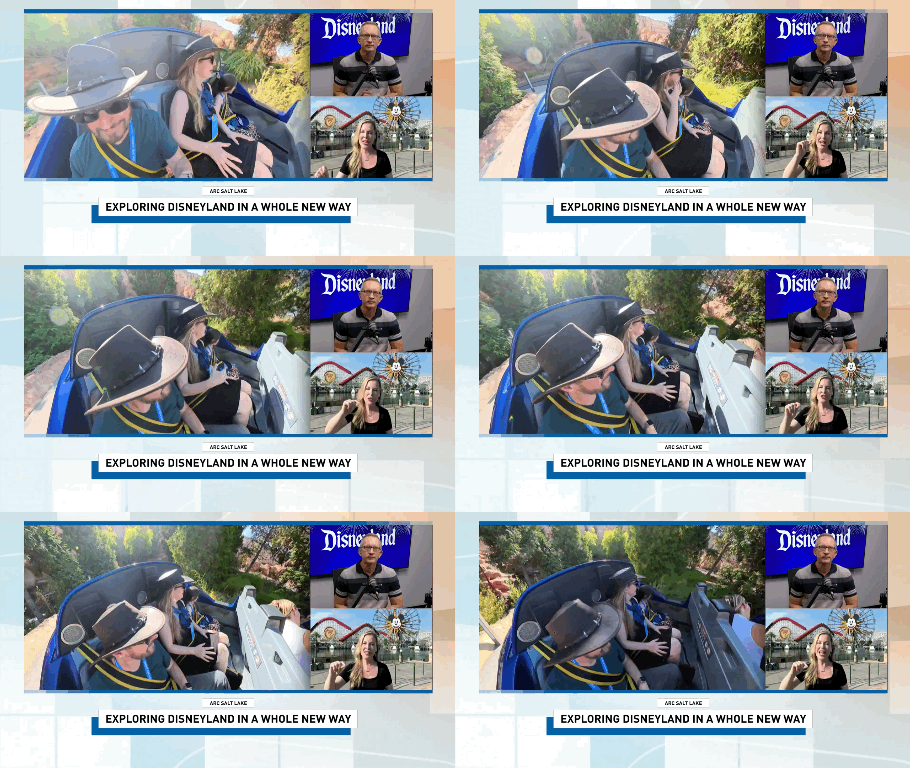
We had a great nearly 10-minute conversation about how parents can use the experiences already built into a theme park to spark curiosity about history, science, engineering, culture, storytelling and more.
What you’re seeing below is an excerpt from that conversation.
The idea behind our HEART Method™ is pretty simple: you don’t have to turn vacation into school to make it educational. In fact, I think the best learning often happens when children don’t realize they’re learning at all.
A ride can become a physics lesson. Architecture can open the door to history. A landscape can lead to geology. Music and food can introduce culture. A movie or character can send a child back to a book. And sometimes, all it takes is asking one question:
“How did they do that?”
(Be sure to follow FoodFamilyTravel.com on News Break and on Instagram: @food.family.travel for the latest travel & lifestyle stories, trends and tips)
Looking at Disneyland Differently
When families walk through Disneyland or Disney California Adventure, there is so much happening beyond the attractions themselves.
Disney is incredibly intentional about creating a sense of place. The buildings, landscaping, music, food, plants, signs, colors and even the way different areas transition into one another are all part of the storytelling.
Once you start noticing those details, the park becomes a fascinating place to explore.
That’s really where our HEART Method™ comes in.
H — History & Humanities
Look for the stories, people, cultures and historical influences behind what you’re experiencing.
E — Engineering & Exploration
Ask how something was designed, constructed or made to work.
A — Arts & Culture
Notice architecture, music, food, visual design, performance and traditions.
R — Reading & Research
Use something your child encounters as a jumping-off point for books, stories or further investigation.
T — Technology & Science
Look for the physics, technology, biology, chemistry and other science making the experience possible.
You don’t have to consciously work through every letter while you’re walking around the park. Think of HEART more as a way of looking.
The Questions Are Often More Important Than the Answers
One of the things I talked about during our CBS conversation is that parents don’t need to be the experts.
That may actually be one of the most freeing parts of this approach.
If your child asks, “Why does that ride move so fast?” and you don’t know, you don’t need to have a perfectly prepared answer.
You can simply say:
“I don’t know. Let’s find out.”
That turns the moment into an investigation.
Before an attraction, you can ask your child to make a prediction. What do they think will happen? Why do they think the ride is designed a certain way? What do they notice about the building or environment around them?
Then afterward, ask whether their prediction was right.
LOOK → ASK → PREDICT → INVESTIGATE.
It’s a simple process, but it can completely change the way a family experiences a theme park.
There Is More to Disney Than the Rides
That was one of the biggest points I wanted to get across during our CBS segment.
Of course, the rides are fun. That’s why we’re there (I dream about Space Mountain and Haunted Mansion).
But look a little closer and you’ll find incredible opportunities to explore how things work.
At Disney California Adventure, for example, the landscape itself can become a conversation. The architecture and rockwork in Cars Land can lead to questions about the American Southwest, geology and the history of Route 66. The design of different lands can prompt kids to compare environments, time periods and cultures.
And then there are the attractions themselves.
A roller coaster gives you an opportunity to talk about motion, acceleration, gravity, energy and engineering. A show can lead to conversations about music, performance and storytelling. Interactive attractions can introduce technology and game design.
Even something as simple as walking from one land to another can become an observation exercise.
What changed?
Did the music change? The architecture? The landscaping? The colors? The food? The signs?
Why?
Those are the kinds of questions that encourage children to really look at the world around them.
Making Learning Part of the Memory
This is also closely connected to what we call Memory-First Travel™.
For me, the goal isn’t to squeeze more activities into a family vacation. It’s to make the experiences you’re already having more meaningful.
Maybe your child remembers a roller coaster because you talked about why it felt different from another ride.
Maybe they remember Cars Land because they became fascinated with Route 66.
Maybe they notice architecture for the first time.
Maybe they come home and start researching dinosaurs, animation, the history of California or how a special effect was created.
That’s the kind of learning I love.
It begins with something tangible and exciting, and then follows your child home.
Years later, you may not remember every attraction you rode that day. But you might remember the question your child asked in the middle of it.
And that can become the memory.
From Disneyland to Universal Studios Hollywood
This is also why we’ve been creating our free HEART Method companion guides for families.
We started with Disneyland and Disney California Adventure, and then took the same approach to Universal Studios Hollywood.
Each park has completely different opportunities for exploration.
Disney opens the door to its incredible mix of storytelling, history, culture, design and technology. Universal offers a fascinating look at filmmaking, special effects, engineering, animation, game design and the process of creating worlds that feel real.
The goal with the guides isn’t to give families homework.
It’s to give parents ideas.
Things to notice. Questions to ask. Places to slow down. Connections to make.
You can use as much or as little of it as works for your family.
Watch the CBS Conversation
I loved having the opportunity to spend nearly 10 minutes talking with CBS Salt Lake City about this approach. The excerpt above gives you a taste of the conversation and why I think this can be such a fun way for families to experience the parks together.
Because ultimately, I don’t want parents to walk into a theme park thinking, How can I make this educational?
I want them to walk in thinking:
What can we discover here?
That small shift can change everything.
You can still ride the rides. Eat the treats. Take the family photos. Meet the characters. Stay until the fireworks.
Just stop every once in a while and look a little closer.
The learning is already there.
You just have to know where to look.
To watch the full segment from CBS, click here: https://www.youtube.com/watch?v=ixQgCOXxIPw
Download the Free HEART Method Guides
If you’re planning a theme park trip, we’ve created free guides to help you put this approach into practice:
- Disneyland: A Parent’s Guide to Making Disneyland an Educational Adventure
- Disney California Adventure: A Parent’s Guide to Making Disney California Adventure an Educational Adventure
- Universal Studios Hollywood: A Parent’s Guide to Making Universal Studios Hollywood an Educational Adventure
Download all three free guides here and take them with you on your next family adventure.
Because the best kind of learning doesn’t feel like school.
It feels like discovering something together.