

If you have time over the next few days, there is one record-breaking movie rooted in Greek mythology you need to experience.
And no, I’m not talking about The Odyssey (although you should absolutely see that too).
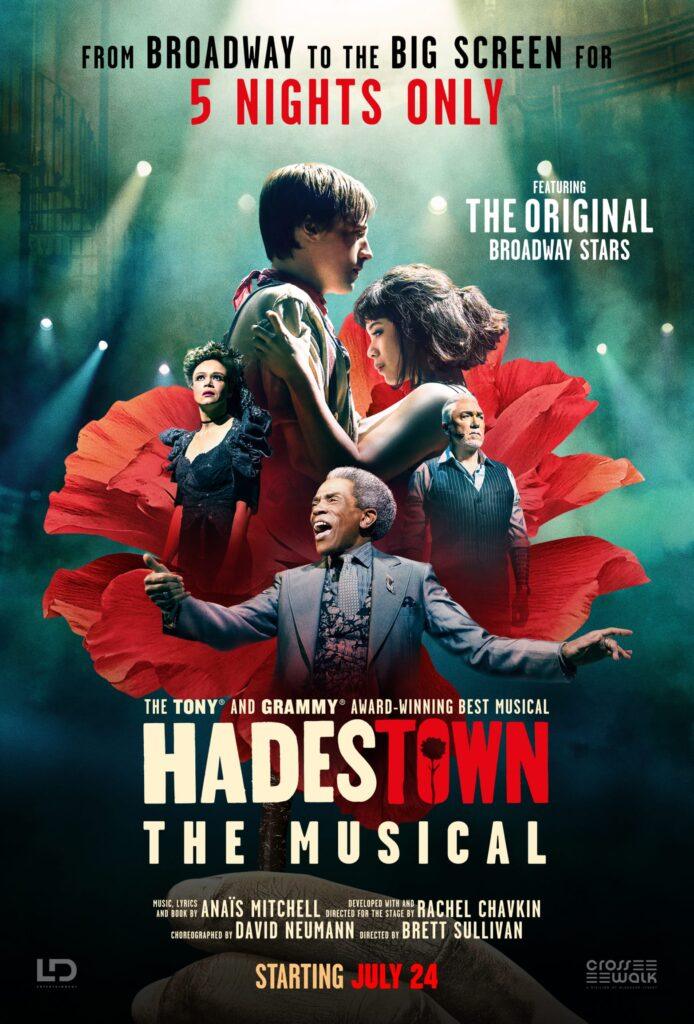
I’m talking about Hadestown: The Musical– the pro-shot film version of the Tony Award-winning musical that has become one of the surprise theatrical events of the summer.
Originally scheduled as a limited five-day theatrical release, Hadestown was extended through at least August 5 before moving to streaming later this summer after overwhelming audience demand. It also broke the record previously held by Hamilton for the biggest opening ever for a movie adaptation of a stage musical.
Our screening was completely sold out (yes, the same opening weekend as Spider-Man: Brand New Day, another record-breaking movie event). From the moment the lights went down, it was clear this was more than just a filmed performance.
It was an experience.
Because the magic of capturing a musical on film is that you preserve something a traditional movie cannot: the energy of the audience and the electricity of a live performance. You feel the emotion in the room. You feel the collective reaction. You feel like you are witnessing something happening in real time.
And perhaps what surprised me most was how deeply Hadestown affected me.
The story of Orpheus and Eurydice is one of the most famous Greek tragedies in history. We know the ending before the journey even begins. Hermes literally tells us from the start that this is a tragedy.
And yet, when the story reaches its devastating climax, audiences still gasp.
That is the power of Hadestown.
It reminds us that the greatest stories are not powerful because we don’t know what happens next. They are powerful because we understand the emotions behind every choice, every sacrifice, and every moment of hope.
(Be sure to follow FoodFamilyTravel.com on News Break and on Instagram: @food.family.travel for the latest stories)
A Tony Award-Winning Musical Reimagined for the Big Screen
Hadestown has already earned its place among Broadway’s most celebrated productions, winning eight Tony Awards, including Best Musical in 2019.
The show blends ancient Greek mythology with a Great Depression-era world filled with rootsy Americana, New Orleans-inspired jazz, and unforgettable storytelling. It follows two interconnected love stories: Orpheus and Eurydice, whose heartbreaking journey takes them into the underworld, and Hades and Persephone, whose fractured relationship mirrors the changing seasons above.
The filmed version brings together the original principal cast, including Reeve Carney as Orpheus, Eva Noblezada as Eurydice, André De Shields as Hermes, Amber Gray as Persephone, and Patrick Page as Hades.
And every single one of them brings something unforgettable.
Reeve Carney’s Orpheus is filled with sincerity and vulnerability. He plays a young musician who believes so completely in the power of love and music that he is willing to travel into the underworld to save Eurydice. There is something incredibly moving about watching someone hold onto hope when the world around him tells him to let go. His voice and “unfinished” song are haunting and beautiful.
Eva Noblezada gives Eurydice strength and complexity. Her character is not simply someone waiting to be rescued- she is someone trying to survive, make difficult choices, and find her way in a world that has become increasingly uncertain.
Then there is Amber Gray’s Persephone.
She is absolutely electrifying.
You can feel every emotion behind her performance. She brings joy, heartbreak, humor, and vulnerability to a character who represents both the beauty and the pain of the changing seasons. Every moment she is on screen has energy behind it. You see her sadness rooted in being trapped underground and in a controlling relationship that is no longer bringing her joy. Persephone is not simply mourning the world above; she is grieving the version of herself she used to be- the goddess of spring, warmth, celebration, and renewal. She longs for the sunlight, the freedom, and the happiness she once shared with Hades before their relationship became defined by power, distance, drinking, and resentment.
And yet, what makes her performance so powerful is that her love for Hades never disappears. Beneath the heartbreak and disappointment, you can still see the deep affection she has for the man he once was and the desperate hope that their relationship can return to what it was before. Amber Gray captures that impossible combination of pain and devotion so beautifully: a woman who is hurt, but who still loves; who is disappointed, but who still believes there may be something worth saving.
That complexity is what makes Persephone unforgettable. She isn’t simply the goddess of spring or the wife of the ruler of the underworld- she is a woman caught between the life she remembers, the reality she is living, and the hope that love can somehow bloom again. If for no other reason, see it to watch this masterclass of stage acting captured on film.
And André De Shields’ Hermes may be the voice I cannot stop hearing.
As the narrator, guide, and emotional anchor of the story, De Shields carries the audience through this tragedy with wisdom, warmth, humor, and just the right amount of mystery. There is something almost magical about the way he speaks directly to the audience, making you feel less like you are watching an ancient myth unfold and more like you have been personally invited into the story.
His voice has a timeless quality—part storyteller, part mentor, part witness to the events unfolding before us. He reminds us that this is a story that has been told for generations, yet somehow makes every word feel like it is being shared for the very first time.
It is no surprise that De Shields earned a Tony Award for his performance as Hermes. His presence is unforgettable, and his songs have been stuck in my head ever since I watched the film. He doesn’t just perform the music- he gives the audience a reason to listen.
The same is true of the incredible vocal work throughout Hadestown, especially from The Fates. Their harmonies are haunting, beautiful, and almost otherworldly. What makes their performances so impressive is that you can still hear the individuality of each voice while appreciating the power of the three voices blending together as one. They create a sound that feels like a warning, a memory, and a prophecy all at the same time.
And that is one of the reasons this film experience is so extraordinary. Every layer of sound matters- from the orchestra to the vocals to the smallest details of the performance. The music does not simply accompany the story; it carries the emotion of the story.
Kudos to the sound recording and mixing team. I wouldn’t be surprised to see this incredible work recognized during award season.
The Hades Performance That Turned an Injury Into Art
One of the most remarkable behind-the-scenes stories belongs to Patrick Page, who plays Hades.
Just four weeks before filming began, Page tore his Achilles tendon.
Yes- an actual injury with a connection to Greek mythology.
He had to perform wearing a medical boot, something that could have easily been a limitation. Instead, it became part of his portrayal of the ruler of the underworld.
Rather than trying to hide it, Page incorporated it into the character. The result was a performance that felt even more powerful. He moved across the stage with the intensity of a caged animal- controlled, intimidating, and full of barely contained energy.
It was unexpected. It was undoubtedly painful. And yet, it became one of those rare moments where an obstacle created something artistically brilliant.
The Summer of the Greek Revival
Hadestown arrives at a fascinating moment.
This feels like the summer of the Greek and mythology revival.
Audiences are once again embracing ancient stories, legendary heroes, impossible journeys, and timeless questions about love, sacrifice, and what it means to be human.
But the reason these myths continue to resonate thousands of years later is because they were never really just about gods and monsters.
They were always about us.
They are about choosing hope when the odds are against you. About loving someone so deeply you are willing to risk everything. About whether we can change a story that feels destined to end a certain way.
And I believe the impact of Hadestown will extend far beyond movie theaters.
It will inspire new generations to discover mythology. It will remind audiences why these stories have survived for centuries. And it will prove that even the oldest stories in the world can still feel completely alive.
At FoodFamilyTravel, we talk often about Memory-First Living™- the idea that the experiences we remember most are the ones that make us feel something deeply.
Hadestown is exactly that kind of experience.
Because the greatest stories don’t have to surprise us.
Sometimes, the most powerful stories are the ones we already know by heart.