

What if one of the easiest places to get kids excited about history, science, culture, geography, and storytelling is somewhere they already want to be?
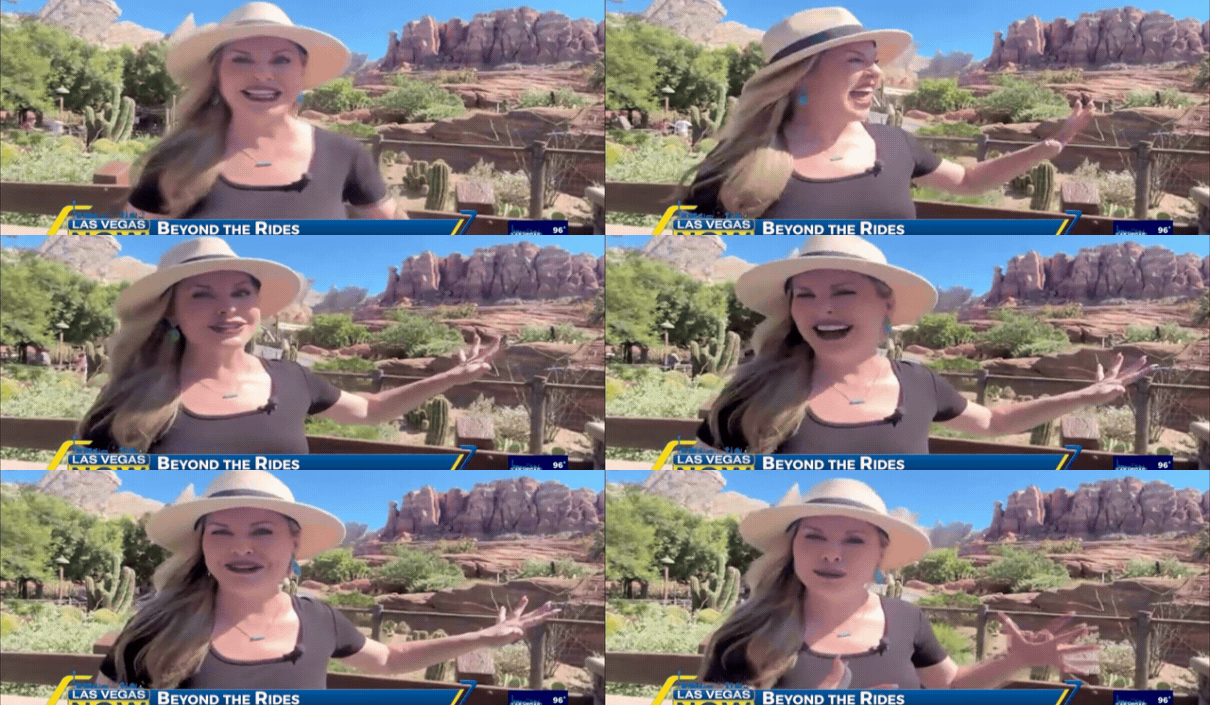
That was the idea I recently shared LIVE with CBS Las Vegas from Disney California Adventure in Anaheim, where we talked about our HEART Method™ and how families can look at theme parks through a completely different lens.
I’ve always believed some of the best learning happens when we are actually experiencing something. When children can see it, touch it, hear it, taste it, and ask questions about it, the information becomes part of a memory rather than something they simply have to memorize. That’s one of the reasons I love experiential travel so much – and why I think theme parks are such fascinating places for families. Disney does this brilliantly. The level of detail, storytelling, and sense of place is so immersive that you could spend hours looking for the little details, and each one can reveal another piece of the bigger story.
Because there is so much more happening than the rides.
Our HEART Method™ gives parents a simple framework for noticing it:
H — History & Humanities
E — Engineering & Exploration
A — Arts & Culture
R — Reading & Research
T — Technology & Science
The goal is not to turn vacation into school. In fact, it’s exactly the opposite. The idea is to show parents that the learning is already built into the experience. You just have to know what to look for and, occasionally, ask a question that gets your child thinking.
(Be sure to follow FoodFamilyTravel.com on News Break and on Instagram: @food.family.travel for the latest travel & lifestyle stories, trends and tips)
Start by Looking Around You
Take Cars Land at Disney California Adventure, for example. Most kids will immediately recognize Radiator Springs from Cars, and there is certainly nothing wrong with simply enjoying the incredible experience. But if you slow down for a minute, there is an entire lesson hiding in the landscape.
The land includes approximately 280,000 square feet of hand-sculpted and painted rockwork designed to evoke the American Southwest. Those massive rock formations aren’t simply a backdrop; they create a sense of place that can lead to conversations about geology, geography, erosion, climate, and the natural environment.
You can ask your child why they think the rocks look the way they do. Why are they different colors? How do landscapes like this form? What happens to rock over thousands or millions of years? You don’t have to know all of the answers. In fact, one of my favorite things to say when traveling with our daughter is, “I don’t know. Let’s find out.”
Then there’s the history woven into the land.
Radiator Springs is inspired by the landscapes and roadside towns of the American Southwest, with a very deliberate connection to Route 66, the iconic highway that became synonymous with the American road trip (and is celebrating its 100th anniversary this year). Suddenly, a walk through Cars Land can lead to a conversation about why Route 66 matters, how Americans traveled before today’s interstate system, and what life was and is like in the roadside communities that developed along the route.
Even the design of the land gives you clues about the time period it is evoking. Look closely at the cars, signage, buildings and businesses and you’ll see references to the 1950s and 1960s, creating another opportunity to talk about how transportation, architecture, advertising and American popular culture have changed over time.
What looks like a beautifully designed fictional town becomes a jumping-off point for geology, American history, transportation, architecture, art, and cultural history.
And your child is still just having fun.
The Ride Can Be the Science Lesson
Then, of course, there is the Incredicoaster, which was right behind me during our earlier CBS Salt Lake City shot.
This is where the HEART Method can make something as familiar as a roller coaster surprisingly interesting. We can talk about speed, force, acceleration, motion, and engineering, but one of my favorite comparisons is between a modern launch coaster and a more traditional roller coaster.
The Incredicoaster launches riders from 0 to 55 miles per hour in under four seconds using a specialized launch system, reaches a peak of approximately 122 feet, and stretches about 6,072 feet.
Instead of simply asking, “Was that fast?” try asking your child why the ride feels so different from a traditional coaster.
A traditional roller coaster generally builds potential energy by pulling the train up a large hill. As the train moves downhill, that gravitational potential energy is converted into kinetic energy – the energy of motion. A launch coaster approaches the experience differently, using a propulsion system to rapidly accelerate the train.
The result is a completely different sensation, even though both rides are governed by the same fundamental laws of physics.
That gives parents a really simple opportunity to ask: Where did the energy come from? Why did the launch feel different from going up a hill? What forces did you feel? What do you think would happen if the coaster were heavier or the launch were slower?
You haven’t added a science lesson to your vacation. You’ve turned something your child already wants to experience into a reason to be curious.
The Environment Is Part of the Story
One of the things I find most fascinating about theme parks is how much the environment changes the way we experience an attraction.
Walk from one themed area into another and suddenly the architecture changes. The music changes. The colors, landscaping, food, signage, smells, and even the materials used in the buildings change. Before you ever ride an attraction, your brain is already being told that you’ve entered somewhere different.
That is storytelling through architecture, art, music, design, and culture.
Parents can make a game out of noticing those differences. Ask your kids, “What feels different here?” or “Why do you think they chose this music?” Look at the buildings and ask what part of the world or what period of history they appear to represent. Talk about the plants, the colors, and even the food.
It’s a wonderful way to introduce children to the idea that places have identities and that designers use visual and sensory details to create a particular sense of place.
And this is where I think theme parks can be especially powerful for younger children. They may not know the terminology for architecture or cultural geography, but they are incredibly good observers. When we give them permission to notice and ask questions, we are helping them develop those skills naturally.
Culture, Traditions and Storytelling
Another great example is Plaza de la Familia at Disney California Adventure, which celebrates the everlasting bonds of family through Día de los Muertos.
It’s an opportunity to talk about music, art, family, remembrance and cultural traditions – and also a chance to explain that Día de los Muertos is a distinct tradition and is not simply another version of Halloween.
That distinction becomes particularly interesting during Halloween Time, when the parks are simultaneously offering seasonal Halloween experiences. Parents can ask their kids what they notice about the different traditions, how the artwork and music communicate different ideas, and why the park uses different visual elements to tell different stories. You can even honor loved ones who have passed with the Memory Wall.
Again, the point isn’t to turn the experience into a lecture. It’s to notice what is already there and let your child’s questions guide the conversation.
Parents Don’t Have to Have All the Answers
This is probably the most important part of the HEART Method for me: parents don’t have to be the experts.
If your child asks a question and you don’t know the answer, that’s actually a great opportunity. “I don’t know. Let’s find out” teaches children something incredibly valuable – that curiosity is a reason to investigate, not a reason to stop.
That philosophy is also why we’ve started creating free HEART Method guides for families visiting different theme parks. We want parents to have something they can actually use while they’re in the park, with ideas about what to look for, questions they can ask and ways to continue the conversation after the trip.
We’re beginning with several major theme parks, and we’ll be sharing more as we continue exploring how much learning is hiding in plain sight.
Because the HEART Method is about changing the way we look at experiences. A roller coaster can introduce physics and engineering. A landscape can lead to geology. A themed restaurant can spark a conversation about specialized food, geography, and culture. Architecture can open the door to history. A familiar movie can send a child back to a book. A special effect can get a family talking about technology and what they imagine the future might look like.
And sometimes, all it takes is one question: “Why do you think they designed it this way?”
Turn Curiosity Into the Memory
That’s ultimately what I’m hoping families take away from this. It’s also the heart of what we call Memory-First Travel™ – creating experiences that become the stories and memories your family carries with you long after the trip is over.
You don’t need to add more activities to your vacation or create a schedule full of educational stops. You don’t need worksheets or quizzes. Take a moment to slow down and notice what is already around you.
Look at the rocks. Listen to the music. Notice the architecture. Read the signs. Taste something you’ve never tried. Ask why a ride feels the way it does. Wonder who created something and why.
Those little moments of curiosity can become some of the most memorable parts of a family trip – and sometimes they can inspire a child to go home and research something they encountered at the park.
That is the kind of learning I love: the kind that starts with an experience and keeps going long after the vacation ends.
We’ll be sharing more guides, ideas, and real-world examples here at FoodFamilyTravel.com®, because the next time you walk through your favorite theme park, I want you to see more than just the next ride.
There is a whole world of learning hiding in plain sight.
Downloadable Guides:
Disneyland: A Parent’s Guide to Making Disneyland an Educational Adventure
To watch the full segment on CBS, click HERE: https://www.8newsnow.com/news/las-vegas-now/beyond-the-rides-how-theme-parks-turn-family-fun-into-a-learning-adventure/