

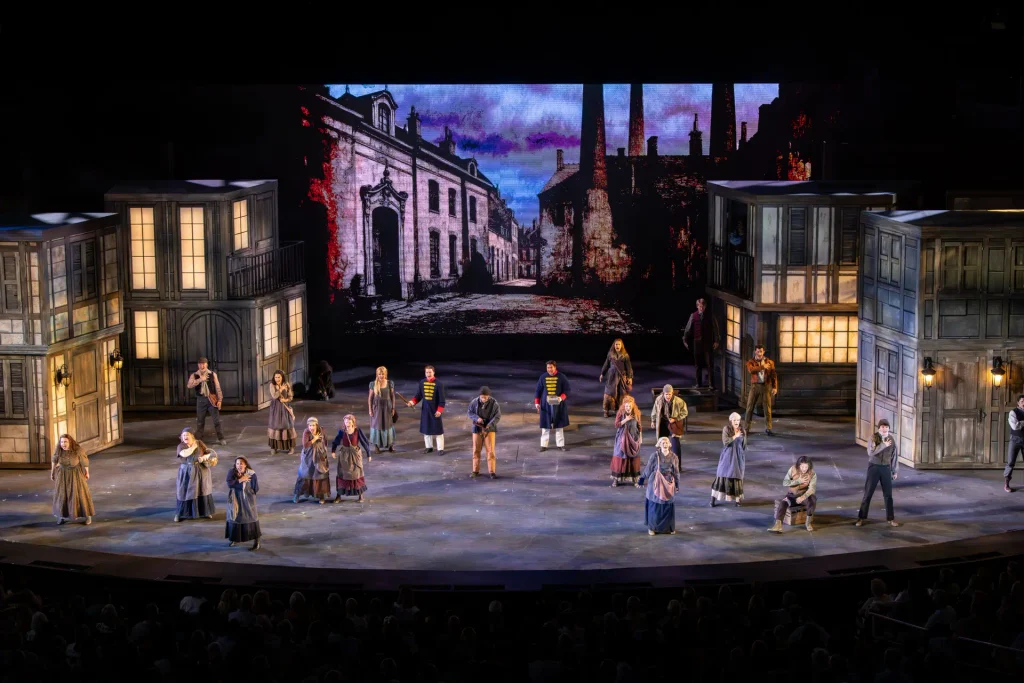
There are moments in live theater that you remember a lifetime.
I have seen Les Misérables more times than I can count, in theaters and cities around the world- from New York to London, San Francisco to Washington, D.C., Boston to Los Angeles, and plenty of places in between. I have watched different Jean Valjeans, Javerts, Éponines and Cosettes interpret the same beloved material. I have heard the score performed in some of the world’s most celebrated theaters.
And then there is Les Misérables at Tuacahn Amphitheatre.
Set against the towering red-rock cliffs of Southern Utah, this production has something no traditional theater can replicate: the landscape itself becomes part of the performance.
There were moments in this production that made the trip to Ivins, Utah, not only worth it- but essential for a theater lover.
In fact, we made the trip from Las Vegas to Ivins twice.
The first night, something happened that is rarely much of an issue at Tuacahn: the weather became a factor. We waited for more than an hour as a light rain moved through, the audience bundled in ponchos and blankets, while the Tuacahn team carefully waited to see whether conditions would improve enough for the performance to go on safely. Ultimately, the show was canceled.
And here’s the part of the story that says almost everything about Tuacahn.
The next day, we were all invited back for the performance. It was a sold-out show, and as I looked around the amphitheater, I honestly couldn’t spot a single new face. The audience had come back. Almost all of us. The same families, couples, theater lovers and fans who had sat through the rain the night before were back in their seats, blankets and ponchos replaced by the anticipation of finally seeing the show.
I don’t share that story as a complaint. Quite the opposite.
I share it because it tells you something about the power of this theater.
I can think of only a handful of venues- and even fewer productions- where a canceled performance could be rescheduled for the following night and have an audience return in such overwhelming numbers, gladly and excitedly (on a weeknight!), to see it. People weren’t simply returning for Les Misérables. They were returning to Tuacahn.
And, in a way, that is the heart of Memory-First Travel™.
We went to Ivins expecting to see a remarkable production of a musical we already loved. We got that- and so much more. We created some of the experiences we expected to have, but we also found ourselves living through moments we never could have planned: sitting in the rain for more than an hour, wondering if the curtain would rise; returning the next night; looking around a sold-out theater and realizing that so many of the people from the night before had come back, too.
Somewhere along the way, the strangers sitting around us became our newfound friends. We shared two nights of anticipation, disappointment, laughter, conversation and, finally, an evening of truly memorable theater together.
Those are the memories you don’t put on an itinerary. They are the ones you carry home with you- and may remember for the rest of your life. And once you arrive at Tuacahn, it’s easy to understand why people feel so strongly about this place. The theater is open to the sky, with the canyon rising behind the stage, creating a setting that feels less like a backdrop and more like another character in the production. There is something almost magical- and, to me, deeply spiritual- about sitting there as the sun disappears behind the rocks and the lights begin to come up.
A Theater Unlike Any Other
Tuacahn Amphitheatre sits at the base of Padre Canyon in Ivins, just outside St. George, Utah, surrounded by enormous red sandstone cliffs. The outdoor amphitheater was completed in 1995 after playwright and St. George resident Doug Stewart envisioned a theater built into the canyon, with the natural cliffs serving as a backdrop. Today, Tuacahn is a major professional theater attracting actors from across the country, including performers who have appeared on Broadway and at other nationally recognized venues.
But statistics don’t really explain Tuacahn. You have to sit there.
Tuacahn’s name was inspired by Teotihuacan, a Mayan word associated with the “city of the gods,” and the theater describes its setting as the “canyon of the gods.” Its stated mission is to inspire and uplift through professional theater and the arts. Sitting beneath those cliffs, it is easy to understand why.
For an actor, I imagine it must be extraordinary. For an audience member, it feels like the boundary between theater and nature disappears. And Les Misérables may be the perfect show for that setting.
Then the Back of the Stage Opens
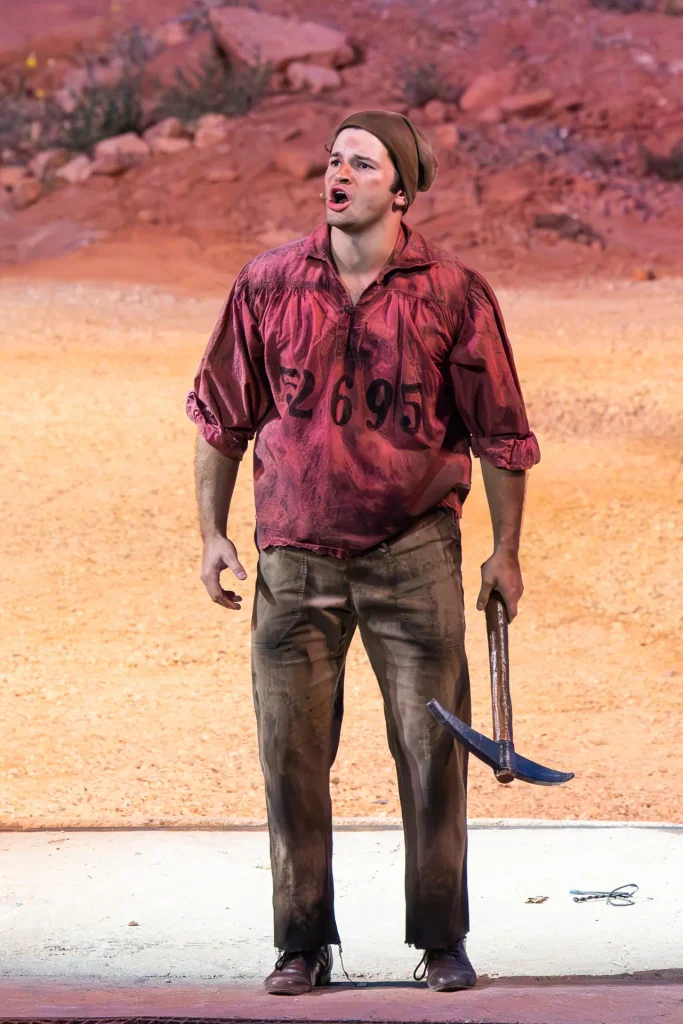
The opening of Les Misérables at Tuacahn is, quite simply, the most spectacular single scene of theater I have ever witnessed anywhere in the world.
That is a big statement.
I mean it.
As the opening sequence unfolds, the back of the stage opens to reveal the canyon beyond. Prisoners work the rocks in a chain gang, swinging pickaxes against boulders. Sparks fly. And then Javert arrives on horseback, riding into the scene on a Clydesdale.
The scale is enormous.
The sound. The movement. The red rocks. The horses. The sparks. The music.
And suddenly this isn’t simply a theatrical representation of 19th-century France. You are watching something that feels elemental.
I found myself tearing up- not because of the familiar story, but because of the sheer spectacle of it.
It was moving. It was startling. And it was, in the truest sense, theatrical.
Tuacahn has been producing Broadway-level theater in this setting for more than 30 years, and its history with Les Misérables goes back to 2008, when it became one of the first regional theaters to receive professional rights to produce the musical. The success of that production helped establish Tuacahn as an important regional theatrical force.
This 2026 production, directed by Sarah Hartmann, takes full advantage of what the theater can do.
And sometimes the staging is astonishing.
Rachel Schoenecker’s Cosette
There are also performances that stay with you.
Rachel Schoenecker’s Cosette is one of them.
I genuinely cannot wait to see what she does next. I would not be surprised to see her on Broadway or the West End very, very soon.
Cosette can be a difficult role. She is essential to the story, but the character is thinly written compared to Fantine, Éponine, or even Madame Thénardier. She simply is not given the same emotional depth or dramatic material as some of the show’s other women on the page.
Schoenecker changes that.
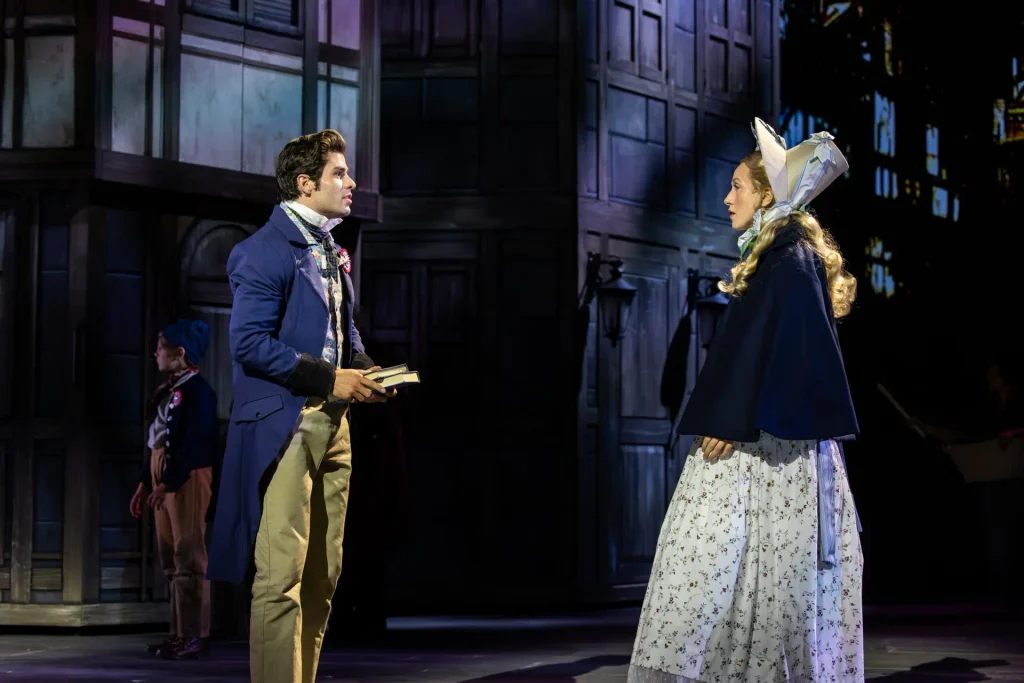
Her vocals are beautiful, but it is her acting that kept pulling my attention back to her. She has an ability to communicate without words- to react, listen, absorb, and reveal what Cosette is feeling without announcing it.
You simply cannot take your eyes off her.
And then there is A Heart Full of Love.
I have always experienced that number as, in some ways, Éponine’s song, with Cosette and Marius almost serving as the happy couple in the background while the audience aches for the girl who knows she cannot have Marius. I have never seen it any other way.
But for the first time, I felt as though I was watching a genuine duet between two lovers- and almost felt as though the audience were intruding on something intimate. J.T. Wood as Marius was fantastic in this scene, and Schoenecker was simply extraordinary.
It was mesmerizing.
That is one of the pleasures of seeing a familiar piece of theater through a new performer. When someone is discovering this extraordinarily rich material rather than simply reproducing it, the audience gets to discover it again, too. She’s, by far, the best Cosette I’ve ever witnessed on stage.
There is something beautiful about watching an actor feel their way through a role for the first time.
After hundreds or thousands of performances, it is understandable that even the most talented performers can develop a kind of protective distance from material this emotionally demanding. That is part of surviving a long theatrical run.
But there is something exhilarating about watching someone connect with it completely.
Schoenecker does.
A Cast Filled With Les Mis Veterans
Tuacahn has assembled a remarkably experienced cast, with numerous performers who have Broadway credits and extensive experience with Les Misérables and other major productions.
David Toole plays Jean Valjean, while Randal Keith takes on Javert. Mindy Smoot Robbins is Fantine, with Kelsey Lee Smith as Éponine and J.T. Wood as Marius.
Keith is particularly fascinating casting for longtime Les Mis fans. He is one of the best-known Jean Valjeans associated with the musical, and now he is on the other side of the pursuit as Javert.
Toole’s Valjean is especially affecting in his quieter moments. There is an emotional intelligence in the performance that doesn’t need to announce itself. His vocals are beautiful, but some of his strongest work happens when he is simply listening or reacting. I found myself moved more than once by his performance.
Smoot Robbins has the kind of voice you expect from a Broadway veteran- powerful, assured and controlled. At times her performance felt more naturally suited to a concert-style presentation and a bit disconnected from the emotion and dramatically intimate world of the story.
Zach Berger as Thénardier and Janna Cardia as Madame Thénardier bring plenty of energy to two characters who are meant to provide some much-needed comic relief amid the weightier moments of Les Misérables. They are larger-than-life characters by nature, but with more restraint, their comic moments could feel even more natural- and, ultimately, even more effective.
The students- Marius’ friends and fellow revolutionaries- were terrific across the board. Their vocals were strong, their acting grounded and committed, and they brought real emotional weight to the barricade scenes. That matters because when the inevitable happens, you feel the weight of the loss in your bones.
The younger performers were wonderful, too. The young Cosette and Éponine brought a freshness and sweetness to the early chapters of the story. There is something particularly special about watching younger actors step into such iconic material and discover these characters for themselves. They remind you that these aren’t simply songs and scenes we’ve seen countless times; they are stories being experienced anew by each generation.
The entire ensemble is exceptional.
In fact, it is one of the best Les Misérables ensembles I have seen anywhere.
That matters enormously in this show. Les Mis is not just about its principal characters. The people filling the streets, the barricades, the factories and the taverns create the world in which the story exists. At Tuacahn, that world feels alive.
Gavroche, the Barricade and a Few Surprises
There are moments in this production that I don’t want to give away.
One is Gavroche’s death. That’s not the spoiler. It’s how it happens. Even when you know exactly what is coming, Tuacahn’s staging makes it genuinely shocking.
Emmitt KLC’s Gavroche is wonderful- adorable, funny, and strong, with the kind of presence that makes you immediately root for him. That makes the inevitable ending even more painful.
It perfectly sets the table for Empty Chairs at Empty Tables.
The staging takes a different approach to the number, and it works beautifully. It gives the song a physical and emotional dimension that made me experience it differently.
Those are the moments that remind you why it is worth seeing a familiar musical again. You know the story, and then someone finds a new way to make you feel it.
This Is a Pilgrimage for Theater Lovers
There are theater productions you recommend, and there are productions you tell people they need to make a pilgrimage to see. Les Misérables at Tuacahn falls into the second category. Part of that is the cast. Part of it is the direction. Part of it is the spectacular staging. But the biggest part may be the place itself.
There is simply no Broadway theater, West End theater, or traditional performing-arts venue that can recreate what happens when the back of a stage opens and the actual Southern Utah canyon becomes part of the production. Tuacahn was designed around that idea from the beginning: theater that exists in conversation with the landscape. Its founders envisioned music echoing from the canyon walls and a stage framed by the towering cliffs.
With Les Misérables, that vision feels particularly complete. Victor Hugo’s story is enormous- about injustice, redemption, sacrifice, love, revolution, mercy, and hope. So is the landscape. And when those two things meet, something happens that is difficult to reproduce anywhere else.
We have not stopped talking about this production since we returned home. I know we’ll be back- year after year- to see what the canyon has to say next.
If you love theater, make the pilgrimage. You may come for Les Misérables. You will remember Tuacahn.
Les Misérables runs at Tuacahn’s Outdoor Amphitheatre through October 23, 2026.